
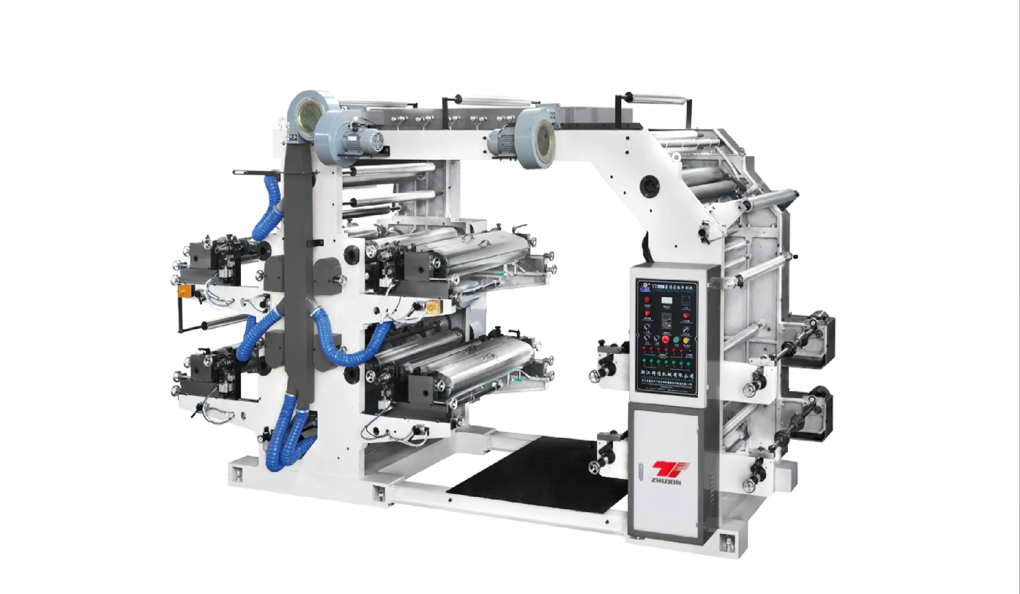
Overview of Paper Bag Inline Flexo Printing
For a paper bag manufacturer, printing has always been a dilemma. Customers demand branded bags, but a separate printing step means extra labor, extra handling, extra floor space, and extra cost. Inline printing resolves the dilemma: a flexo printing unit mounted directly on the paper bag machine prints the design in-line as the bag is formed, turning a two-step production process into one continuous operation. The result is lower cost per bag, faster turnaround, and simpler logistics. This article explains how inline printing works, why it pays off, what to consider when setting it up, and how to keep print quality consistent.
Working Principle and Engineering Requirements
Inline printing integrates one or more flexographic printing stations into the bag machine's paper path. The paper web is printed between unwinding and forming: the flexo unit applies ink to the paper surface, a drying section sets the ink, and the printed web continues into the folding, gluing, and cutting stations of the bag machine.
The configuration is straightforward in concept — print the web, then form it — but it is demanding in engineering. The printing unit must maintain precise registration at the bag machine's production speed, and the drying section must fully set the ink before the paper is folded and glued, otherwise the folds smear the print or the glue fails to bond over ink.
When well engineered — as with the inline flexo options offered on Zhuxin's ZXFD-290 and ZXJD-450 lines — inline printing delivers printed bags from a single machine with one operator overseeing the entire process.
The configuration is straightforward in concept — print the web, then form it — but it is demanding in engineering. The printing unit must maintain precise registration at the bag machine's production speed, and the drying section must fully set the ink before the paper is folded and glued, otherwise the folds smear the print or the glue fails to bond over ink.
When well engineered — as with the inline flexo options offered on Zhuxin's ZXFD-290 and ZXJD-450 lines — inline printing delivers printed bags from a single machine with one operator overseeing the entire process.
Core Business Advantages of Inline Printing
The business case for inline printing rests on eliminating the separate printing operation:
One machine, one operator. A standalone printing step requires its own press, its own operators, and its own scheduling. Inline printing uses the bag machine's existing staff and time.
No double handling. With offline printing, rolls travel to the printer, then to the bag machine, with two setups, two quality inspections, and two opportunities for damage and waste. Inline printing eliminates the entire intermediate step.
Lower inventory of printed stock. Offline producers must pre-print and store rolls of printed paper, tying up capital and risking obsolescence when designs change. Inline producers print exactly what they need, when they need it — design changes take effect immediately.
Faster order turnaround. A rush order for 50,000 printed bags can ship the same day it is printed and formed, instead of waiting for a separate printing slot.
Reduced capital outlay for startups. An inline-equipped bag machine costs less than a bag machine plus a standalone flexo press, making branded production accessible to smaller factories.
For single-color logo work — the most common demand from bakeries, coffee shops, and takeaway chains — inline printing is typically the lowest-cost production method available.
One machine, one operator. A standalone printing step requires its own press, its own operators, and its own scheduling. Inline printing uses the bag machine's existing staff and time.
No double handling. With offline printing, rolls travel to the printer, then to the bag machine, with two setups, two quality inspections, and two opportunities for damage and waste. Inline printing eliminates the entire intermediate step.
Lower inventory of printed stock. Offline producers must pre-print and store rolls of printed paper, tying up capital and risking obsolescence when designs change. Inline producers print exactly what they need, when they need it — design changes take effect immediately.
Faster order turnaround. A rush order for 50,000 printed bags can ship the same day it is printed and formed, instead of waiting for a separate printing slot.
Reduced capital outlay for startups. An inline-equipped bag machine costs less than a bag machine plus a standalone flexo press, making branded production accessible to smaller factories.
For single-color logo work — the most common demand from bakeries, coffee shops, and takeaway chains — inline printing is typically the lowest-cost production method available.
Key Factors to Consider Before Adopting Inline Printing
Inline printing is not the right answer for every job. Assess these factors before committing:
Number of colors. Inline units typically handle one to four colors. A single-color logo is ideal; four-color process work is possible but demanding on speed and registration. Heavy multi-color or full-coverage designs are better suited to a standalone flexo press.
Print quality expectations. If your customers demand premium, high-resolution reproduction (fine gradients, halftones on white kraft), a dedicated standalone press with more sophisticated controls may be necessary. Inline printing excels at clean, consistent spot-color and simple designs.
Speed trade-off. The printing and drying units add load to the line. Confirm the maximum bag production speed with inline printing active, and make sure it still meets your volume targets.
Paper selection. Smoother papers print more cleanly. Brown kraft is naturally absorbent, so ink lay-down and color appearance differ from white kraft — verify the printed result on your actual material.
Food-grade jobs. If you produce food-contact bags, the inline inks must be low-migration and food-contact compliant, and the drying system must fully cure the ink.
Number of colors. Inline units typically handle one to four colors. A single-color logo is ideal; four-color process work is possible but demanding on speed and registration. Heavy multi-color or full-coverage designs are better suited to a standalone flexo press.
Print quality expectations. If your customers demand premium, high-resolution reproduction (fine gradients, halftones on white kraft), a dedicated standalone press with more sophisticated controls may be necessary. Inline printing excels at clean, consistent spot-color and simple designs.
Speed trade-off. The printing and drying units add load to the line. Confirm the maximum bag production speed with inline printing active, and make sure it still meets your volume targets.
Paper selection. Smoother papers print more cleanly. Brown kraft is naturally absorbent, so ink lay-down and color appearance differ from white kraft — verify the printed result on your actual material.
Food-grade jobs. If you produce food-contact bags, the inline inks must be low-migration and food-contact compliant, and the drying system must fully cure the ink.
Professional Quality Control for Consistent Inline Printing
Consistent inline print quality follows the same discipline as standalone flexo, with an extra layer of in-line monitoring:
Registration checks. Servo-driven synchronization keeps the print registered to the cut length automatically, but verify at job start and periodically — especially after paper roll changes, which can shift the web slightly.
Anilox and ink consistency. Document the anilox roller selection, ink viscosity, and drying temperature for each job, and reproduce them on repeat orders. Viscosity drift is the main cause of color variation within a run.
Drying verification. After the drying section, the ink must be dry to the touch and rub-resistant. A quick rub test with a clean white cloth at job start catches under-dried ink before it smears bags by the hundred.
First-piece approval. Run a few bags, check them against the approved proof (color, registration, glue lines, folds), and only then ramp to full speed.
In-line inspection. Train operators to check a sample from the delivery stack every 15–30 minutes. Catch a defect early and it costs minutes; catch it at the end of the run and it costs the whole shift.
Registration checks. Servo-driven synchronization keeps the print registered to the cut length automatically, but verify at job start and periodically — especially after paper roll changes, which can shift the web slightly.
Anilox and ink consistency. Document the anilox roller selection, ink viscosity, and drying temperature for each job, and reproduce them on repeat orders. Viscosity drift is the main cause of color variation within a run.
Drying verification. After the drying section, the ink must be dry to the touch and rub-resistant. A quick rub test with a clean white cloth at job start catches under-dried ink before it smears bags by the hundred.
First-piece approval. Run a few bags, check them against the approved proof (color, registration, glue lines, folds), and only then ramp to full speed.
In-line inspection. Train operators to check a sample from the delivery stack every 15–30 minutes. Catch a defect early and it costs minutes; catch it at the end of the run and it costs the whole shift.
Application Scenarios and Product Solutions
Inline printing saves money on the jobs it can do well — and that is a wide range. But keep standalone printing in mind for:
- Multi-color process work with high visual complexity
- Very large print areas or heavy ink coverage
- Premium jobs on white kraft requiring the highest print fidelity
- Situations where maximum bag machine speed cannot be sacrificed
Many manufacturers run both: inline units for everyday logo bags, a standalone YT-S flexo press for premium and complex jobs. The two configurations complement each other, and the right mix depends on your customer base.
- Multi-color process work with high visual complexity
- Very large print areas or heavy ink coverage
- Premium jobs on white kraft requiring the highest print fidelity
- Situations where maximum bag machine speed cannot be sacrificed
Many manufacturers run both: inline units for everyday logo bags, a standalone YT-S flexo press for premium and complex jobs. The two configurations complement each other, and the right mix depends on your customer base.
Inline printing on paper bag machines is one of the highest-leverage upgrades available to bag manufacturers. It eliminates a whole production step, cuts labor and handling costs, reduces printed stock inventory, and shortens order lead times — while delivering clean, professional branded bags straight off the bag machine