
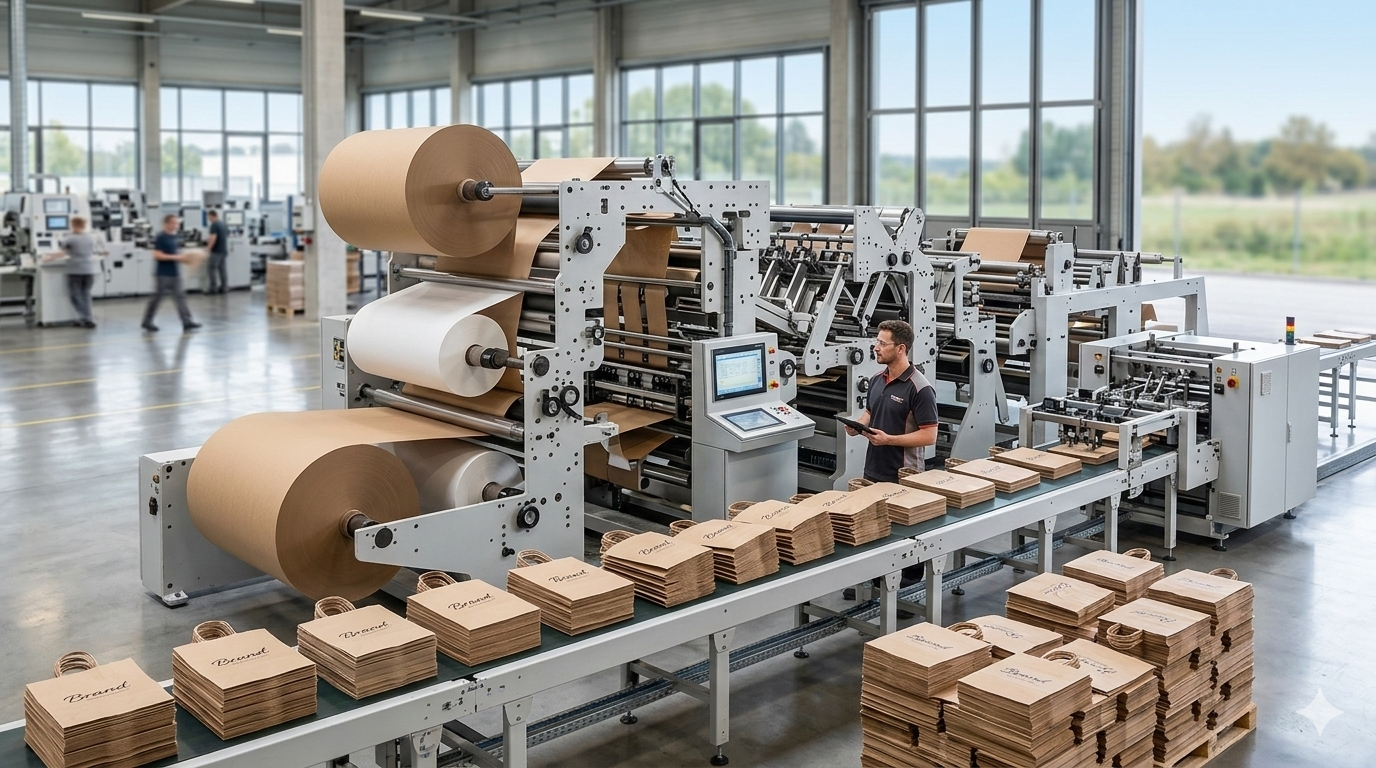
How a Paper Bag Making Machine Works: From Raw Roll to Finished Bag
Unwinding, Printing, and Creasing: Precision Pre-Formation Stages
Making paper bags starts when we unwind those big rolls of kraft paper carefully so it doesn't stretch out or slip around during processing. The printing part comes next where high quality flexo printers put on company logos and designs really accurately, about half a millimeter difference at most which matters a lot for how the brand looks overall. While all that's happening, special rotating wheels create the crease lines for folding, making sure everything folds properly later on without any issues. We know from experience in the packaging world that if these creases aren't right, they cause problems down the line. About one quarter of all defects come from bad creasing actually, so getting this step right is super important for quality control throughout the whole manufacturing process.
Folding, Gluing, and Bottom Forming: Critical Tolerance Control in Square Bottom & Twisted Handle Machines
The automated folding units form the main body of the bags while applying water based adhesive in narrow beads around 0.3mm wide. Square bottom machines have special forming heads that make those side gussets with minimal variation - typically under half a millimeter difference from one bag to the next. This tight control helps keep stacks stable and allows them to hold weight properly. For handle assembly, twisted handle systems can attach reinforced paper rope handles at speeds reaching about 150 units each minute. These connections get sealed using ultrasonic bonding technology which gives consistent strength across all products. When it comes to bottom sealing, manufacturers aim for plus or minus 0.2mm accuracy. Most food grade applications (around 99 out of 100) won't leak if this standard is maintained during production.
Types of Paper Bag Making Machines: Matching Design, Function, and Output Needs
Flat/Satchel, Square Bottom, and Twisted Handle Machines: Structural Differences and Application Fit
There are basically three main types of machines that cater to different functions and markets in the packaging industry. The flat or satchel style makes those simple flat bottom bags with just basic folds and glue work. These are great for lighter stuff we see in stores everyday like bakery items or medicine packs. They're built to run fast and cut down on wasted materials which is good for anyone looking at production costs. Then there's the square bottom machines that create stronger bases by forming those gussets at the bottom. This lets them hold much heavier things without collapsing, so they're perfect for grocery shopping bags or hardware store packages while still stacking neatly when empty. Lastly, twisted handle machines incorporate sturdy paper handles right into the bag itself during manufacturing. The handles stay tight under pressure and look nicer too, making these bags stand out in markets where appearance matters a lot like clothing stores or gift shops.
| Machine Type | Structural Feature | Primary Application |
|---|---|---|
| Flat/Satchel | Minimal folds, flat base | Bakeries, pharmacies |
| Square Bottom | Reinforced gusseted base | Groceries, bulk goods |
| Twisted Handle | Integrated handle attachment | Retail branding, gifts |
Selection hinges on balancing functional requirements—load capacity, handling ergonomics, shelf presence—with production volume and industry compliance expectations. Square bottom models deliver structural performance; twisted handle systems elevate perceived value.
Industrial-Scale Paper Bag Making Machine Performance: Speed, Reliability, and ROI
Throughput Benchmarks: 200–600 Bags/Minute Across Machine Classes
Modern paper bag making machines achieve throughput rates ranging from 200 to 600 bags per minute (BPM), depending on configuration and bag complexity:
- Entry-level units: 200–300 BPM
- Mid-range systems: 300–450 BPM
- Premium automated lines: 450–600 BPM
These speeds are sustained without compromising quality thanks to integrated optical inspection systems that detect flaws in real time—keeping defect rates below 0.5% even at peak output.
CAPEX vs. Operational Savings: 37% Lower Unit Cost at >5M Bags/Year (Freedonia Group, 2023)
While industrial paper bag making machines represent a significant capital investment, their operational efficiencies deliver strong ROI—particularly at scale. Facilities producing over 5 million bags annually realize a 37% reduction in per-unit cost compared to manual or semi-automated methods (Freedonia Group, 2023). Key drivers include:
| Cost Factor | Semi-Automatic Operation | Industrial Automation |
|---|---|---|
| Labor Requirements | 5–8 operators | 1–2 technicians |
| Material Waste | 15–20% | 3–5% |
| Energy Consumption | Standard | 30% Reduction |
| Quality Consistency | Variable | >99.5% Accuracy |
Payback typically occurs within 18–24 months. Servo-controlled folding eliminates alignment errors responsible for 7–12% rework, while automated glue application reduces adhesive waste by 40%.
FAQ
What are the pre-formation stages in paper bag making?
Pre-formation stages involve unwinding kraft paper rolls, printing with flexo printers, and creating crease lines. These steps ensure proper folding, accurate branding, and reduce potential defects.
What types of paper bag making machines are there?
There are three main types of machines: Flat/Satchel, Square Bottom, and Twisted Handle. Each is suited for different applications such as bakeries, groceries, and retail branding respectively.
How do industrial paper bag machines improve efficiency?
Industrial machines enhance efficiency through high-speed operations (200-600 bags per minute), quality control, and reduced material waste. They also offer significant operational savings vs. semi-automated methods.