
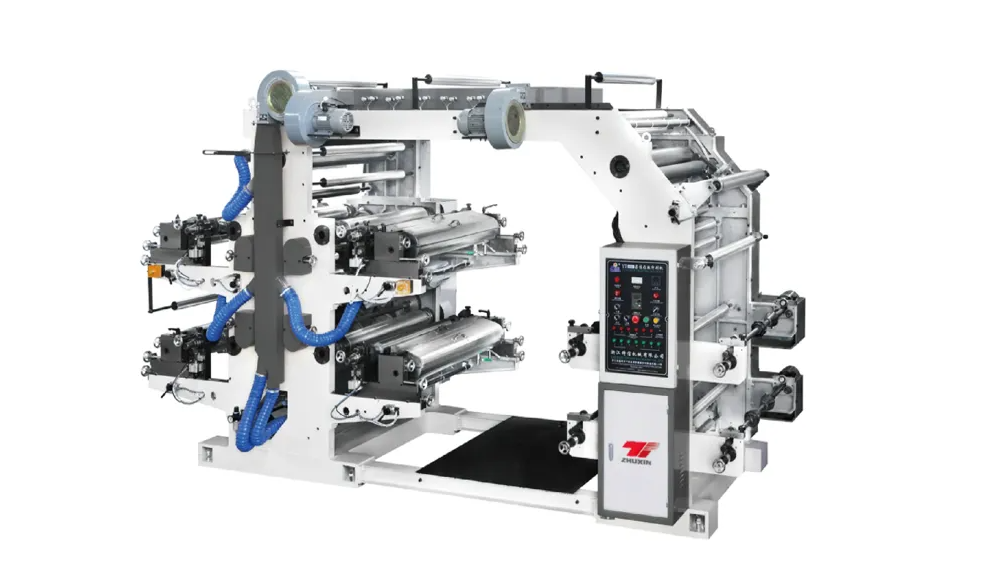
A plain kraft bag carries a product. A printed kraft bag carries a brand. That difference explains why flexographic printing has become the most widely used printing method in the paper bag industry. Flexo is fast, economical, and versatile — capable of printing everything from a simple logo to four-color artwork directly on paper at speeds that keep pace with modern bag production lines. Whether you are buying your first flexo printing machine or looking to improve print quality on an existing line, understanding the technology, the process, and how to control quality will directly affect your product's appearance and your cost per bag.
1. What Is Flexographic Printing?
Flexography is a rotary printing process that uses flexible relief plates — usually made of photopolymer — mounted on plate cylinders. The process follows a simple sequence:
-
Ink is transferred from a reservoir through an anilox roller, which has thousands of tiny engraved cells that meter a precise volume of ink.
-
The plate cylinder picks up ink only on the raised image areas of the plate.
-
The print cylinder presses the inked plate against the paper web, transferring the image.
-
Drying follows immediately, either through heat, air circulation, or UV curing, so the next color can be printed without smearing.
Because the plates are flexible and the process is rotary, flexo prints at very high speed — the Zhuxin YT-S series flexo printing machines reach up to 160 m/min — while maintaining consistent quality across long runs.
2. Choosing the Right Ink
Choosing the right ink is essential for print quality, drying speed, and food safety:
-
Water-based inks are the industry standard for paper bags. They dry by absorption and evaporation, produce low VOC emissions, and are safe for food-contact packaging when formulated accordingly. Most bag producers run water-based inks exclusively.
-
UV-curable inks cure instantly under ultraviolet light, allowing printing on non-porous surfaces and very fast line speeds. They offer excellent rub resistance but cost more and require UV curing units.
-
Soy-based and vegetable-based inks offer an environmentally friendly profile with good color strength, increasingly popular for eco-branded packaging.
For food-contact applications, verify that your ink supplier provides compliance documentation for relevant regulations, such as EU food-contact framework requirements for printing inks.
3. Color Management: Getting Consistent Results
Consistent color is what separates professional packaging from amateur printing. Follow these steps to control color through the entire process:
-
Design with the right color space. Convert your artwork to CMYK or spot colors at the design stage. Pantone spot colors are recommended for brand logos that must match precisely across batches.
-
Proof before production. Review a physical proof — a printed sample from the actual plates — rather than trusting a screen preview. Paper absorbs ink differently than the screen suggests, especially on brown kraft.
-
Control anilox rollers. The cell volume of the anilox roller determines ink transfer. Match the anilox to the application: coarse screens for solid areas, fine screens for details and gradients.
-
Standardize your press conditions. Document ink viscosity, press speed, and drying settings for each job, and reproduce them every time. Viscosity variation is the number one cause of color drift during a run.
-
Manage substrate color. Brown kraft paper has a natural color that shifts how printed colors appear. Design with this in mind, or switch to white kraft or pre-coated paper when the brand requires bright, accurate colors.
4. Quality Control: A Practical Routine
A robust QC routine catches defects before they reach your customers:
-
Register control: Ensure each color aligns within the tolerance specified for the job (typically ±0.5 mm or tighter for fine work). Modern servo-driven machines hold registration automatically, but operators should check periodically.
-
Density and color checks: Use a densitometer or spectrophotometer to verify ink density and color values against the approved proof, especially at the start of a run and after any ink change.
-
Ink adhesion testing: Test that the ink does not rub off or flake. A simple tape-pull test is a quick field check; more rigorous rub testing can be specified for demanding customers.
-
Inspection on the fly: Use strobe lights or a video inspection system at the delivery end to spot defects early. Stopping a run to fix a defect costs far less than reprinting a full batch.
-
Documentation: Keep a QC record for every job — plate ID, anilox used, ink batch, viscosity readings, and sample approvals. When a customer complains, the record tells you immediately what changed.
5. Equipment Configurations: Standalone vs. Inline
Two configurations dominate the industry:
-
Standalone flexo printing machines print rolls of paper or printed sheets before bag forming, offering maximum flexibility and print quality.
-
Inline printing units mounted on the bag machine print directly during bag production, saving labor and handling — at the cost of some flexibility and speed.
Many factories run both: inline flexo for simple single-color logos, and a standalone YT-S series printer for multi-color or heavy-coverage jobs.
Conclusion
Flexographic printing is the workhorse of paper bag decoration for good reason: it is fast, economical, and capable of excellent quality when the process is understood and controlled. Master the four pillars — process knowledge, correct ink selection, disciplined color management, and systematic quality control — and your printed bags will look professional, consistent, and worth the premium price your customers pay for branded packaging.
Zhejiang Zhuxin Machinery manufactures the YT-S series flexo printing machines, reaching speeds up to 160 m/min, and integrates inline flexo units with our paper bag machines for one-stop production. Our ISO 9001 certified team provides full installation, training, and lifetime after-sales support. Contact Zhuxin to discuss a printing configuration that matches your bag production line and quality goals.